Tuesday, March 25, 2014

The Voice of China in Africa

An interesting conference on China and Africa (mainly Mozambique) in Maputo hosted by the Institute for Social and Economic Studies (IESE). Their website has links to some of the presentations and papers. Several are in Portuguese and the others are in English. I haven't read any, but I note that the impressive Sergio Chichava did a presentation on representations of China in the Mozambican press, and there is also a paper by the father of African studies in China, Li Anshan. Well done IESE.
h/t to Lynn Salinger, reporting from Maputo.

Monday, March 24, 2014

Four DC Events for China-Africa Watchers


Four exciting events on the schedule for China-Africa watchers who will be in Washington, DC in the next two months:

1. On Friday, March 28, 9:00 am – 11:00 am at the Carnegie Endowment for International Peace, 1779 Massachusetts Ave. NW, the Sister Cities program will report on their China-Africa Initiative, with Lula Chen from Sister Cities, adviser Prof. Tang Xiaoyang from Tsinghua University, and others.

2. Friday evening, 28 March, 4th China-Africa researchers happy hour at Teaism, 400 8th St. NW hosted by Winslow Robertson, who publishes the blog Cowries and Rice, and a newsletter on China-Africa issues.  For more information click here.

3. Prof. Graeme Smith from Australia National University will speak on China's Growing Aid Program in the Pacific: Cooperation or Competition with Australia? April 8, 2014 at 12:30 pm – 2:00 pm Johns Hopkins SAIS, Bernstein-Offit Building, Room 736, 1717 Massachusetts Ave. NW. Graeme has been doing fantastic research on China in the South Pacific. Many parallels with Africa.

4. Save the date for the SAIS China Africa Research Initiative conference on China's Agricultural Investment in Africa: 'Land grabs' or 'Friendship farms'? at the Johns Hopkins School of Advanced International Studies, Rome Auditorium, 1618 Massachusetts Ave. NW, Friday May 16, 2014, 9:00 to 5:30.

Friday, March 14, 2014

Guest Post: China, Business, & Human Rights: "Inside Out"

Guiding PrinciplesThe following is a guest post by Motoko Aizawa:* 

“Inside out, and outside in, but not inside in.”  According to John Ruggie, now the Berthold Beitz Professor of International Affairs at the Kennedy School of Government at Harvard University, this was the mantra that the Chinese offered as a way to steer Ruggie’s mandate as the Special Representative of the Secretary-General on human rights and transnational corporations and other business enterprises.  Cryptic?  Here’s the translation:  It would be OK for Ruggie’s business and human rights mandate to address the behavior of Chinese companies doing business outside China (“inside out”), and it’s OK for foreign companies operating inside China (“outside in”), but it’s not OK for the Chinese companies operating in China, or “inside in,” as that is the exclusive domain of Chinese law and sovereignty.

The output of Ruggie’s mandate (2005 to 2011) was none other than the UN Guiding Principles on Business and Human Rights (the GPs), an influential soft law instrument endorsed unanimously by the Human Rights Council, including China.  As a soft law instrument, the GPs are not binding international agreements.  On the other hand, they address all business activities, domestic and international.  So how does the Chinese mantra on international and domestic trade and investment measure up against the GPs?

Tuesday, March 11, 2014

China's Trillions in Aid to Africa

Photo credit: Feng Lei, China Foto Press Gamma
Is China providing trillions in aid to Africa? Apparently Mugabe's government in Zimbabwe thought so, and they were disappointed when their effort to reap a mere $30 billion in budget support fizzled in the face of the reality: Chinese finance is far more modest than this. Official aid is especially limited. And unlike the West, China rarely gives direct budget support. When it does, the amount is generally tiny:  $5 million.

Give us bankable projects to finance, the Chinese told Mugabe's government. This is how Chinese finance operates: project finance, generally for infrastructure, or export credits, which can finance imports from China. Mugabe's government ought to know this. They've taken out Chinese loans for tractors and farming inputs. Our China-Africa loan database shows that the biggest loan from China to Zimbabwe was in 2007:  $200 million for agricultural equipment.

So what about those stories about a "trillion in Chinese finance for Africa" by 2025? Don't believe it. This would entail some $85 billion a year, up from current levels of about $10 billion. The absorptive capacity isn't there, nor are the "bankable projects" of that magnitude. 

Friday, March 7, 2014

Bonanza: Open Access to Articles on China-Africa Issues

The publishing house Taylor & Francis is giving open access to dozens of journal articles on China-Africa issues (including one of mine, with Zhang Haisen). For people outside of universities, which can access these for free, this could be very useful.  One warning: some of these are fairly dated and the research has moved on considerably since then. And the quality of these articles also varies quite a bit, with some based on very solid empirical foundations and others relying more on news media and secondary sources. Caveat readers.


Here's the publisher's description of this bonanza:
China is increasingly becoming involved in all aspects of development within Africa. From infrastructure building to the investment in aid on the continent. The following articles explore this growing relationship, looking at the impact on US – African relations, the media view on the partnership and China’s aid policies within the region. You can now explore over 35 leading papers on China in Africa entirely for free below.

Monday, February 17, 2014

China, Africa, and "Land-Grabs" Redux

Chinese farm est. in 1992, Zambia
At last, the realities of the lack of evidence on Chinese "land grabs" in Africa seems to be penetrating the world of scholarship. A new article in the French journal Futuribles by Jean-Jacques Gabas uses updated "databases" to make the argument  for a re-think on this issue. My own view is that the databases are still deeply flawed. I am familiar with a number of Chinese investment activities that have not made it into the databases, and several that remain in, although they have never happened. Ah well.

Futuribles n° 398, janvier/février 2014.
La Chine est-elle un accapareur de terres en Afrique ? Retour sur une réalité mal acceptée

With sustained economic and demographic growth, a rising standard of living among its inhabitants and a growing demand for food, China has considerable efforts to make to meet the growing needs of its population. In this context, it has often been criticized by observers who take the view that it is evincing a form of neo-colonialism towards the African continent, not only with regard to mineral resources, but also in the areas of land ownership and agriculture. What is the actual situation? Can China perhaps be seen as a country that is making a massive land-grab in Africa?

In the view of Jean-Jacques Gabas, drawing here on the two most reliable databases on land acquisition across the world, the actual picture is more mixed than it seems. Gabas first re-situates China within world agricultural trade, then provides an insight into global land transactions and a league table of the biggest investors in land, in which China comes sixth, far behind the USA. He then details where these investments have mostly been made and, with regard to the main African countries concerned, indicates the (small) proportion represented by Chinese investment. Lastly, he shows that Africa is not a geographical priority so far as Chinese investment in land is concerned, specifies the nature of Chinese projects on African soil and stresses China’s increasing tendency to focus its activity in Africa on development aid.

Friday, February 14, 2014

Who is San Mao, the romantic chronicler of China-Africa relations?


Not long ago, I received an email from Tom Devriendt, an editor of Africa is a Country, "a blog that engages with reporting on Africa". He asked me if I knew of San Mao (三毛):


I recently came across the name of Chinese/Taiwanese writer San Mao. To be honest, I had never heard of her before. She turns out to have been a prolific writer, and -- some claim -- her work remains important (for better or for worse) in shaping a popular image of Africa in China.
Some references I've found on the web include:
- a trailer for a documentary (which never seems to have been finished): http://vimeo.com/8005426

- and a couple of blog features:
  h
ttp://www.idealshanghai.com/features/1717/

http://thelostseasons.wordpress.com/2010/02/16/the-life-of-san-mao%E3%80%8A%E5%9B%9E%E5%A3%B0%E3%80%8B/

Africa is a Country is interested in finding out more about San Mao, and so am I. Do any readers know more? Has anyone heard of her?


Update, February 18: We find, thanks to a tweet from Winslow Robertson @Winslow_R and another from Paul Farrelly @paul_farrelly a fascinating article about San Mao in the journal of East Asian History: "San Mao Makes History" and "San Mao Goes Shopping."  Wow. Twitter as a research tool?

Further update. I realized belatedly that San Mao was my favorite singer when I lived in Taiwan. I adored her song Olive Tree: "Do not ask me from where I have come, My home is far, far away. Why do you wander so far? Wander so far?" 


Sunday, January 26, 2014

The China-Comoros malaria eradication experiment

Artemisinin    photo credit: Action Medeor/Brigitte Betzelt
The Economist of January 25, 2014, carried an article by Shannon van Sant -- Malaria eradication: cure all? that analyzes the fascinating and controversial effort by Chinese researchers, a Chinese drug company, and the Government of the Comoros to eradicate malaria across their three islands, and 700,000 people, using several rounds of an malaria treatment: artemisinin, developed from a Chinese herb, for the entire population, one by one. The questions she raises are good ones. Being myself in the middle of an intensive, months-long IRB (Institutional Review Board) process at Johns Hopkins to allow me to move forward on grant-funded research on Chinese agricultural investment, I can say that (no surprise) it appears that China lags behind in imposing rigorous safeguards for ethical research practice.
  • are side-effects being monitored in a systematic way?
  • are people who participate doing so with adequately informed consent?
  • how commercial is the motivation, given the involvement of China's Ministry of Commerce and the Chinese drug company? 
Van Sant concludes with two interesting comments. First, she notes the point made by the Minister of Health in the Comoros, Dr Mhadji, that Western criticism may not be unbiased: "Not that the West is a disinterested party, for Western firms, too, manufacture artemisinin-based malaria therapies. On that point Dr Mhadji has strong views. He dismisses criticism of the experiment as fuelled by competition between Western and Chinese pharmaceutical companies." And she concludes with two great quotes from Nick White and Oscar Wilde:
As Nick White, a malaria researcher at Oxford University’s School of Tropical Medicine who has been working for years on eradicating malaria, says, “This research is radical. It is controversial. It is led by a very famous Chinese physician and investigator. There are lots of very serious questions here and a lot of unknowns.” Or, as Oscar Wilde more succinctly put it, “The truth is rarely pure and never simple.”
A lot of reporting went into this story. It is very well-balanced and insightful, and pulls in informed voices from different sides of the debate. Other islands (Mauritius, for example) eradicated malaria by compulsory spraying of DDT inside people's houses. This option is no longer available and obviously contained its own risks. I'm not a public health expert -- but I'm interested in comments from readers who are: what is your take on this experiment? What is the WHO position on it?

Friday, January 17, 2014

Chinese and Belgian Aid in the Congo

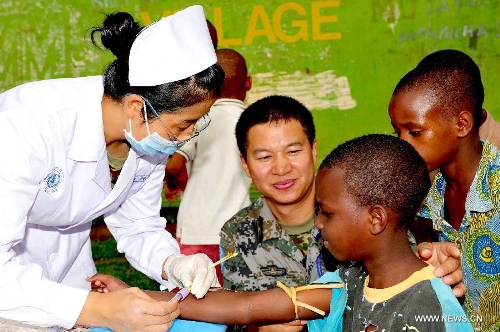
Chinese doctors in the DRC. photo: Global Times
Ignace Pollet, et al, Neither Conflict Nor Comfort: The Co-Habitation of Chinese and Belgian Aid in the Congo. (Leuven, 2011). Somehow I missed this Belgian-Chinese comparative study when it was first published in 2011. A systematic, comparative look at Belgian and Chinese aid in the DRC, with a historical flavor. Done by a team of Belgian, Congolese and Chinese researchers who used a common framework to evaluate pairs of projects. Some points that struck me (all excerpts from the study):


  • Chinese Aid to the DRC is not new, but the study finds that, contrary to the general perception amongst the Western and Congolese public, it is small in terms of volume and scope (only few individual projects in the sectors of road building, health, school building). In contrast, Belgian Aid to the DRC is sizeable, consisting of rather complex projects in the sectors of road infrastructure, agriculture and education.


  • Belgian projects generally achieve a strong local involvement because of the participatory nature of the projects and the way they are institutionalised. Chinese projects generate a similar level of involvement by their focus on visible output-oriented projects that are often of direct use to the local population. 


  • Chinese projects that are part of commercial contracts, are often wrongly perceived as Aid by the local population.


  • Chinese Aid lacks the attention for capacity building and institutional integration (of Belgian aid), but still achieves similar levels of sustainability as the Belgian projects, because it focuses mainly on economical infrastructure and tends to follow up the projects for long periods.


  • Although medical cooperation will be continued as a part of China’s diplomacy, China is now actively exploring how it can be fitted into its new cooperation model, featuring the mutual benefit component. This means that Chinese enterprises will be stimulated to enter the recipient country’s market, as a first step in the outward-looking strategy of the Chinese medical industry.
  • Monday, January 6, 2014

    Call for Papers: Conference on China, Africa, and Agricutural Investment

    DB in Liberia, Kpatawee Farm, 1983
    The Paul H. Nitze School of Advanced International Studies (SAIS) SAIS China Africa Research Initiative (SAIS-CARI) announces a call for papers for a Conference on China, Africa, and Agricultural Investment, May 16 and 17, 2014.

    Call for Papers

    The SAIS China Africa Research Initiative (SAIS-CARI) will hold an inaugural public conference on May 16, 2014 and private research workshop on May 17, 2014, in Washington, DC at Johns Hopkins University’s School of Advanced International Studies (SAIS). The theme will be Researching China’s Agricultural Investment in Africa:  ‘Land Grabs’ or ‘Friendship Farms’? The goal will be a deeper, comparative understanding of the motives and experiences of Chinese investors; the network of relationships: investors, governments in China (national and provincial) and in Africa, intermediaries and brokers; and the impact of their investments.

    We are pleased to announce a Call for Papers for this conference and workshop and a Small Grant competition, with funding from the Smith Richardson Foundation. Proposals can be submitted at any time but are due by February 14, 2014.

    Papers are welcome on the following topics:

    • Life histories and/or narratives of Chinese agricultural investors’ experience
    • Studies of the business model behind China’s agro-technology demonstration centers.
    • Environmental and social impact of Chinese agricultural investments
    • Economic and/or financial analysis of specific investments
    • Studies of failed investments that specify what happened and why
    • Comparisons between Chinese investments and those by other investors
    • Comparisons between Chinese investments in Africa and in other regions

    The list is for suggestion only; other topics are also welcome. All papers must be based on fieldwork and focus on case studies of specific investments or projects. Applicants are welcome to discuss their proposed research with the conference organizers before making a proposal. Comparisons between Chinese and other investors would be particularly welcome, or comparisons between Chinese agricultural investments in Africa and in other regions (including China). 

    Prospective authors should submit a two page proposal to SAIS-CARI@jhu.edu by February 14, 2014. Proposals should include a 300 word abstract of the paper, a brief description of the research project and methodology, and a short biography of the author. A limited amount of travel support will be available for selected researchers to attend the conference. Authors should indicate whether they need travel support in order to participate.

    Small research grants

    In addition, approximately five small grants of $3000 will be awarded for researchers (including advanced masters and Ph.D. students) to (a) conduct an initial, scoping visit to a Chinese agricultural investment project in Africa, or (b) pay a return visit to such a project in order to update research carried out previously. Visits should be concluded prior to the conference, although exceptions may be made. Applicants should apply separately for the small grant, providing a one page statement of the specific purpose for which it will be used, and any prior research conducted on this topic. Researchers will be expected to report their findings at the conference.

    Application Deadline:       February 14, 2014
    Notification:                      February 21, 2014
    Deadline for Papers:          April 15, 2014
    Conference:                       May 16-17, 2014

    Papers can be in English, French, Portuguese or Chinese, but applications and presentations must be made in English.

    For further information, please email: SAIS-CARI@jhu.edu

    Thursday, January 2, 2014

    Irene Sun: Chinese Businesses and Corruption in Nigeria

    Irene Yuan Sun's analysis of Chinese Businesses and Corruption in Nigeria as published in The Guardian (Lagos), September 21, 2013. Here, Irene finds herself in a Lagos market, unexpectedly translating the negotiations between Chinese and Nigerian businessmen over the cost of importing a container of contraband blue jeans. She concludes this provocative article with this summary:

    Many Nigerians have the impression that the Chinese are incredibly corrupt. I would make a slight modification: the Chinese in Nigeria are incredibly corrupt, because the Nigerians in Nigeria are incredibly corrupt.
    What I mean is this: on their own, the Chinese are neither devils nor angels. They simply amplify the characteristics of the existing business environment in Nigeria. For now, this means that they aid and abet corrupt practices, because that is what individual Nigerians demand as the price to play in the Nigerian market. Unlike Western businesses or development institutions, the Chinese generally do not speak English fluently, so they cannot read the laws for themselves. Moreover, they are here to make money, not to take a stand for law and order. All of this means that the Chinese have the effect of reinforcing the status quo, and today, that status quo is the corrupt diversion of public monies into private hands.

    As this textile importation example shows, for Nigeria’s business environment to improve, it will require not only passing thoughtful legislation, but also honoring those laws in everyday practice. But the power is in Nigeria’s hands. The Chinese will go to great lengths to do business in Nigeria; today, they brave murky laws, shady characters, and underhanded practices to play in this market.
    Imagine what they would do if Nigeria cleaned up its act.

    Monday, December 30, 2013

    Nigeria: Labour Practices in Chinese Factories

    A Chinese biscuit factory in Nigeria. photo credit: Paolo Woods
    I've been snowed under (so to speak) with work and travel for the last six weeks or so. I hope to blog more in the new year, since it's one of the most fun parts of my professional life. Meanwhile, I'll be posting some links to other interesting material on China's "going global", particularly in Africa.

    Irene Yuan Sun, author of the popular post on this blog, "A Blind Date in Namibia," spent some of last summer in Nigeria, where she wrote up her keen observations in two articles for the Guardian (Lagos). In her first article, "Labour Practices in Chinese Factories," (October 19, 2013), Irene notes that investors from Hong Kong have been running factories in Nigeria for several decades. One factory is one of the world's largest makers of flip-flops, another, just opened, will be one of the world's largest producers of rolled-steel. An earlier Guardian article by Okechukwu Onwuka, "No power, no infrastructure, Yet Chinese factories are flourishing in Nigeria," also comments on this phenomenon.

    Chinese employers have been criticized by NGOs and others in Nigeria for operating factories where workers are treated "more or less like slaves" -- yet most critics have not themselves actually been inside a Chinese (or Hong Kong) factory in Nigeria. Irene, who is bilingual, visited eight factories to observe their work conditions. She observed large variations in lighting, cleanliness, whether workers had protective clothing and safety equipment, yet, she says, the gates at "several of the factories I visited were crowded with Nigerians who were hoping to find work."

    Labor relations are one of the most commonly cited issues in the China-Africa engagement. Irene's suggestions for bilingual labor mediators at each factory and random safety inspections are good ones -- but hard to put into practice. Safety inspections with bite require a government that cares about workers. However, with the rapid expansion of Chinese language courses in Africa, the language of advocacy, labor relations, and mediation might shift from being exclusively English/French/Portuguese to include a focus on communication with the continent's newly significant investors from China.

    Thursday, November 21, 2013

    Opportunity: SAIS Ph.D. Program, China-Africa Economic Engagement

    I am looking for an excellent candidate to undertake Ph.D. research on China-Africa economic engagement under my supervision, to enter in the Fall of 2014. SAIS offers fully funded Ph.D. fellowships. Candidates must already have an MA degree, ideally in development studies, economics, or international relations.

    The ideal candidate will have some background in China-Africa relations, fluency in Chinese including the ability to read Chinese, field experience, and excellent English. Admission will depend on academic excellence (high GPA, excellent GRE scores), and a convincing statement of research interests that includes China's going-out engagement in Africa, broadly defined. Quantitative skills (econometrics), Portuguese or French would be assets, but not required. 

    The deadline for applications is December 15. For more information, and to apply, consult the SAIS Ph.D. program website here.

    Tuesday, November 19, 2013

    New Research on China, Africa, and the Media

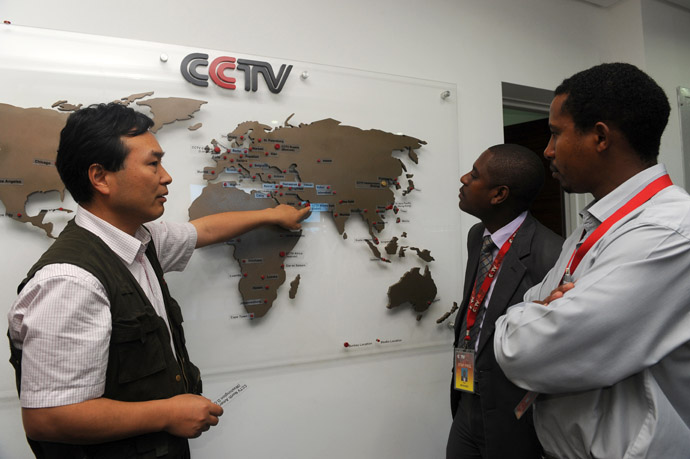
    The South African journal Ecquid Novi:  African Journalism Studies has a special issue (v. 34, n. 3) on China and Africa. For the moment (and this likely won't last) the issue appears to be available for free.  I haven't read all the articles yet, but I see several scholars I recognize, including Bob Weseka from Kenya who has written for this blog, and Iginio Gagliardone, who used "participant observation" to analyze CCTV in Africa. Download while you can.  h/t to Yoon Jung Park

    Saturday, November 16, 2013

    China and the Phillipines: Humanitarian Aid

    A week after Typhoon Haiyan hit the Philippines, the Chinese have been bit players in the response, with an initial pledge of 10 million yuan ($1.6 million) in-kind aid, and $200,000 in cash. Is this all we can expect? Probably not. Yet while all the news stories on the meager Chinese donations usually note that China has "the world's second largest economy," they usually fail to put China's generosity (or lack) into context. Context helps to understand Chinese actions in two ways.

    First, any donation should properly be judged against not against a country's absolute wealth but in relation to its wealth and population: i.e. wealth on a per capita basis. Seen from this perspective, China falls to #92 in the list of prosperity (using the World Bank's measure of 2012 GDP/pc, or per capita, PPP). With a per capita GDP of $9,233, the Chinese are far less wealthy than the countries that have contributed the most to the relief effort, so far: the UK ($32 million, $36,950 GDP/pc), Australia ($30 million; $44,598 GDP/pc), and the US ($20 million; $49,965 GDP/pc). (Many of these countries have also pledged in-kind assistance). Still, the response could have been more generous. Indeed, as I outline below, a historical perspective shows just how paltry the Chinese response has been so far, and how much it likely has to do with Chinese bitterness about the Philippine's recent actions in the South China Seas.

    Second, China has been more generous in other humanitarian disasters. China is not a new player at humanitarian aid. Shipments of food in times of famine are a familiar element in Chinese assistance. The Chinese Red Cross has been providing disaster aid since at least 1981.  In 1985, the Chinese Red Cross raised $5 million for famine relief in Africa. After the Haiti earthquake, the Chinese pledged over $7 million in cash assistance.

    History helps put China's paltry assistance to the Philippines into perspective. Below is a section from my book on China's aid program, The Dragon's Gift, pp. 121-122.
    ... [Over the past decades,] China has given bilateral earthquake relief to Algeria and Iran, mud avalanche relief to the Philippines, tents, mosquito nets, and blankets to Iraq and Somalia, and even donated $5 million after the Katrina hurricane disaster in the United States...
    ... Today, China’s humanitarian aid has greatly increased, consistent with Beijing’s relatively new desire to project itself as a “responsible major power.” It is also increasingly being channeled multilaterally, as in Zimbabwe’s 2009 drought, when the Chinese made a $5 million cash donation to support WFP [World Food Program] operations.

    This new multilateralism began during the 2004 Indian Ocean tsunami. At first, China reacted unilaterally, as its foreign emergency response mechanism swung into motion. Wang Hanjiang, then head of the Department of Foreign Aid, met quickly with his counterpart in the Ministry of Foreign Affairs to map out the first steps in China’s response. After getting approval from the State Council, they called in the Foreign Affairs Office of the Chinese Ministry of National Defense, and the Ministry of Civil Affairs, which carried out the tasks.

    The Chinese were proud that a planeload of supplies from China was the first foreign aid to arrive in Sri Lanka, flown directly from a Beijing factory only two days after the disaster. Chinese medical teams and engineers were posted to a number of countries struck by the tidal wave. But then China publicly pledged more than $60 million, and channeled almost a third of this through the UN – a first. (Some in the region speculated that China’s historic response was partly done to outgun Taiwan, which had pledged $50 million for the recovery effort.) Private citizens in China donated more than $61 million through the Chinese Red Cross and the China Charity Federation. With the disaster of the Pakistan earthquake following the tsunami, China’s official bilateral humanitarian aid for 2005 ultimately totaled nearly $128 million, with NGOs and Chinese companies raising an almost equal amount.
    I anticipate that Chinese aid to the Philippines will rise, but Beijing will not be able to easily play down the conclusion that their response to this disaster was stingy, and petty.

    Monday, October 28, 2013

    China's Environmental Impact in Africa: New Evidence


    Curious about China's environmental impact in Africa? See this new piece by Daniel Compagnon and Audrey Alejandro, "China's External Environmental Policy: Understanding China's Environmental Impact in Africa* and How It Is Addressed", Environmental Practice, 15(3), 2013.  While we still lack systematic, cross-national evidence on this impact, this article is a good example of the growing trend of scholars doing fieldwork and subjecting the conventional wisdom on Chinese external engagement to the test of evidence. The authors' research suggests that in South Africa, "Chinese companies are as compliant as the Western ones—and perhaps more than Indian companies—when it comes to local law, be it on labor or environmental issues." They emphasize the importance of local African agency in determining environmental outcomes. It also contains a helpful overview of changing policies on the environment and going global, in China.

    Article abstract: "Many Chinese economic actors in Africa have come under harsh criticism for the alleged environmental impact of their activities. This impact is not always documented, is uneven across the continent, and should be compared to that of business actors from other countries—in particular
    from the OECD. One major factor accounts for the recorded differences: the policy and regulatory framework within which these business actors operate. The African weak state is not conducive to the adoption of robust standards and their subsequent implementation. However, the shift in Chinese policy at home on environmental issues is already producing some changes for the state-owned companies, and there is a growing concern in China’s leading circles about the international image of the nation and its companies turning global."


    h/t to Yoon Jung Park. *Update: when I wrote this, the article was accessible free, online. That's apparently no longer the case. Apologies. Thanks to @krizcpec for pointing this out.

    Tuesday, October 22, 2013

    TI: Chinese Multinationals Score Low on Transparency


    A new report from Transparency International rated Chinese companies lowest among 100 companies from the emerging market countries for levels of transparency. This has implications for African countries and civil societies. 

    Beijing has required little of its firms. Yet what is also interesting is that two Chinese firms were among the five best performers, with regard to transparency (below). Unfortunately for Africa, two of the firms that operate on a large scale across the continent, Huawei and CNOOC, are also among the firms that scored 0 on TI's scale (below). Add to this the zero rating of Brazil's huge engineering firm, Odebrecht Group, and the challenges for transparency in Africa are apparent. It would be interesting to study the "best" and "worst" Chinese firms on this list to discover why some have chosen to adhere to a growing international norm, while others choose to remain opaque.

    ORGANISATIONAL TRANSPARENCY: THE GOOD AND THE NOT-SO-GOOD
    SCORED 100%SCORED 0%
    Emirates Airlines (UAE)Anshan Iron and Steel Group (China)
    Johnson Electric (China)Chery Automobile (China)
    Petronas (Malaysia)China National Offshore Oil Corporation (China)
    Shanghai Electric (China)China Shipbuilding Industry Corporation (China)
    United Company Rusal (Russia)Chint Group (China)
     Galanz Group (China)
     Geely – Zhejiang Geely Holding Group (China)
     Huawei Technologies (China)
     Mabe (Mexico)
     Odebrecht Group (Brazil)
     Wanxiang Group (China)
     Source: Transparency International. 100 = most transparent. 0 = least transparent. 

    Friday, October 18, 2013

    Guest Post: A Kenyan's Tales from the Beijing Subway


    This guest post is courtesy of Bob Wekesa, Kenyan journalist and Ph.D. candidate at China Communications University.
     
    When I first came to China in the autumn of 2011, it was with feelings clear as mud. On the optimistic expectations continuum, I was all upbeat about imbibing a new culture framed as mystical and mysterious. On the opposite end of the spectrum, I was wary of China’s reputation as a communist state. My mind raced hither and thither even as the Emirates Airways taxied on the runways of Jomo Kenyatta International Airport in Nairobi bound due East.


    Arriving at Beijing Capital Airport on the evening of September 8, I and would be classmates at Communication University of China were received by volunteer students. I was mesmerized by the sheer smoothness and neatness of the roads as a courtesy bus conveyed us to China and Asia’s foremost media and journalist school. The more distance we covered away from the airport toward the university, the more I was charmed by the complexity of the road network: underpasses here, flyovers there; endless road safety rails that would long have been vandalized were it in Nairobi; service roads aplenty, name it? 

    Something else struck me – the absence of pedestrians on the airport highway! Wasn’t this the capital of the world’s most populous nation? Hadn’t I read that Beijing itself was on course to top 20 million residents in short order? Where are the Chinese ‘commoners’, I mused!

    The answer to my bewilderment over the absence of Chinese pedestrians would come to me powerfully once I settled down on campus and started venturing out. My very first encounter with throngs of Chinese was within days of arrival when colleagues from Tanzania, Belarus and Nigeria went to the Sanilitun diplomatic enclave to register our presence with our embassies. 

    Two young Chinese students offered to help us reach our embassies. At the Communication University of China station on the Batong Line, we were baptized into the Beijing subway culture. Although we left for the diplomatic district mid afternoon that bright October day, we found the trains packed to the brim. Drive on Mbagathi Road in Nairobi any working day morning and what strikes you is the great number of manual laborers walking to Industrial Area work from Africa’s largest slum - Kibera. Aha, when you don’t see the Chinese on Beijing highways, they are commuting underground in their millions! 

    It was evident that some of the Chinese passengers were encountering black people for the first time, judging from the glances and gazes we were attracting. I am not too sure if I am less conscious today than I was two years ago but it appears there are fewer darts directed at me nowadays when on board the subway. The number of Africans (or blacks for that matter) coming to Beijing has shot up over the past two years. New African students mingling with Chinese people must have helped break cultural barriers in a way that a television feature can never do.  

    The Beijing subway is a study in convenience if one gets the hang of navigating it. Peak hours are to be avoided like the plague on account of the jam-packed crowding, and cramming in Beijing takes on a particularly buffeting quality! Five pm is particularly rough as commuters often stampede into the trains where one has to reckon with being squeezed as well as the resulting odors. This is when you come face to face with the foibles of living in a populous nation, notwithstanding the many positives of ‘strength in numbers’. Off peak however, the subway is less packed. Thus, unless absolutely necessary, many foreign students plan their sojourns away from universities between 9.00 am and 4.00 pm or any time after 7.30 pm. 

    A journalist colleague has pointed out that the number of skyscrapers in Beijing could be as many as the number of high rise buildings in all the African cities together. This claim is rather hyperbolic. But the fact remains that locating a building on your own in Beijing is a complex affair on account of the many buildings in the sprawling city. Here, the subway comes in handy in that it serves as a location marker. I have found it convenient to be directed to any rendezvous by for instance arranging to meet a contact at the entrance/exit of a subway station. It’s not uncommon for one to pose: “well, this building is near which subway station?”

    Quite apart from the fact that I get fewer quizzical looks when I use Beijing subways nowadays, I have gained other sociological-cum-psychological insights, albeit neophyte. As a rule of thumb, when a fellow Chinese subway commuter fixes me with a glance, I look back straight and he or she will surely avert his or her gaze. Better still, if someone looks at me a little bit intensely and we are within short distance, I will offer a greeting. Often ‘ni hao’ leads to some conversation; in once case, I have developed a long term relationship on the basis of a mere subway greeting. However, if I am not up to any of these strategies, I opt to whip out my phone and delve into any online engagement.

    Chinese kids are particularly flummoxed when they meet an African, on the subway, in a public park or elsewhere. The trick, I have learned is to be playful with the kid and even make faces and the kid is your buddy (often the parent as well). I have also learned that older folk are likely to give you that quizzical look than are the middle aged Chinese – I propose the younger people have witnessed China’s opening up relative to older folk. I also now know that most of the subway commuters who seem so mesmerized by Africans would be new to Beijing, visiting from other Chinese provinces or the outskirts of the city where exposure to Africans is less. 

    Just so that we could test our thesis that ‘Beijingers’ in the outer districts are less exposed to Africans, a colleague from Lesotho and I recently commuted to Tuqiao, the terminal of the Batong line in East Beijing. There we went into a restaurant and ordered a drink but the surprise written on ‘fuyuwuan’ the waiter’s face as well as other patrons at the bar served to confirm our suppositions.    
       
    In a nutshell, the Beijing subway has countless tales to tell.

    The author is a Kenyan journalist and PhD in communication candidate at Communication University of China. He is also a fellow of the China-Africa Reporting Project at University of the Witwatersrand, South Africa. Contact: bobwekesa@gmail.com.